
PragTob
Benchee & formatters - easy and extensible (micro) benchmarking
Hi all,
I just build and released my first hex.pm package. It’s a (micro) benchmarking tool somewhat inspired by ruby’s benchmark-ips. It’s goal is to be easy to use, nice output, extensible through plugins and to provide you with statistics, to better see how reliable your results are. So far the statistics provided are average, iterations per second, standard
deviation and median.
It also comes with the first plugin, BencheeCSV to format output as CSV for easy usage with spreadsheet tools so you can make pretty graphs etc.
Announcement blog post:
benchee
- github GitHub - bencheeorg/benchee: Easy and extensible benchmarking in Elixir providing you with lots of statistics!
- hex benchee | Hex
benchee_csv
- github GitHub - bencheeorg/benchee_csv: Output your Benchee benchmarks as CSV to generate graphs in your favorite spreadsheet tool!
- hex benchee_csv | Hex
Thanks, enjoy benchmarking and feedback welcome 
Tobi
Most Liked
PragTob
Hi everyone,
I didn’t want to “spam” the form with release announcements after my initial post about benchee back in June but I figured with all the changes and new features now might be a good time to write something again! If it’s too much, please tell me
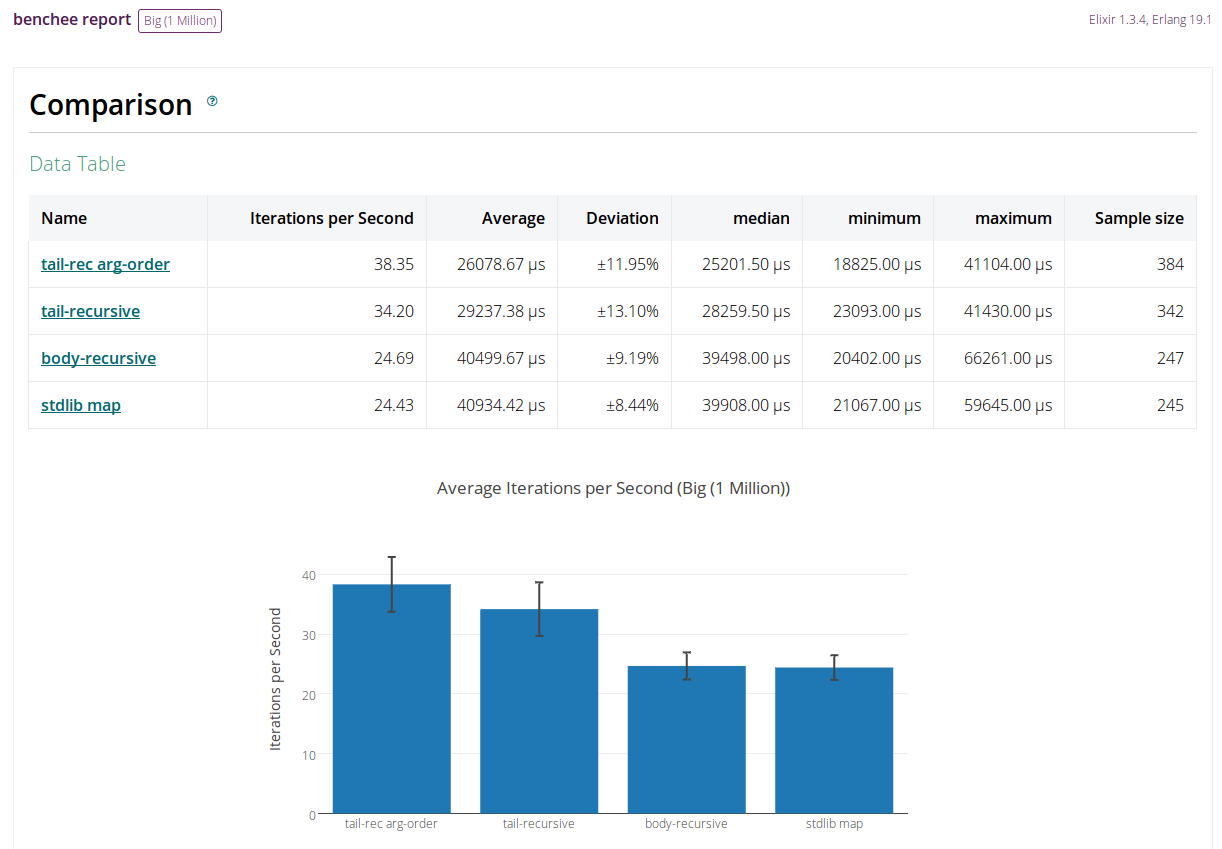
I just released new versions of my benchmarking library benchee along with benchee_csv, also introducing new formatters benchee_json and finally benchee_html to create nice HTML reports, with 4 different graphs that can also be exported as PNG images! And of course, there also is a blog post about all of it.
benchee has come a long way and I’m particularly excited about it supporting running your suite with different inputs as different implementations may behave differently depending on input size or structure. Also I changed the API of the main interface after a short but good discussion in this very forum. And I gotta say it looks way more elixir now
alias Benchee.Formatters.{Console, HTML}
map_fun = fn(i) -> i + 1 end
inputs = %{
  "Small (10 Thousand)"    => Enum.to_list(1..10_000),
  "Middle (100 Thousand)" => Enum.to_list(1..100_000),
  "Big (1 Million)"       => Enum.to_list(1..1_000_000),
}

Benchee.run %{
  "tail-recursive" =>
    fn(list) -> MyMap.map_tco(list, map_fun) end,
  "stdlib map" =>
    fn(list) -> Enum.map(list, map_fun) end,
  "body-recursive" =>
    fn(list) -> MyMap.map_body(list, map_fun) end,
  "tail-rec arg-order" =>
    fn(list) -> MyMap.map_tco_arg_order(list, map_fun) end
}, time: 10, warmup: 10, inputs: inputs,
   formatters: [&Console.output/1, &HTML.output/1],
   html: [file: "bench/output/tco_detailed.html"]
This then produces outputs thanks to the HTML formatter as you can see in this example report or get a preview with this image:
So yeah, I hope you like it. Would be great to hear what you like, or even better what you are missing, not liking or bugs so that I can improve and extend benchee and its associated libraries
Thanks!
Tobi
PragTob
So here is what was promised! Benchee 0.99 and 1.0 (along with all plugins) are a reality 
There aren’t many super hardcore new features, except for showing the absolute difference in the average of measurements to help arguments & informed decisions. Otherwise it’s some polish, documentation, house keeping etc.
0.99 introduces a bunch of deprecation warnings, when you eliminate them you should be good to upgrade to 1.0.
I also want to thank everyone here for their input etc 
Happy benchmarking
PragTob
Hello friends, long time no see. Enjoy a new Benchee version with a bugfix (finally!), reduction counting and profiler after benchmarking (yay!) as well as some musings on Open Source and why it took so long.
PragTob
And 0.14.0 is finally live for your pleasure! The major feature is drastically increased precision when measuring: from microseconds to nanoseconds! There’s a blog post showing off the most important changes but you can also check out the Changelog with all the changes.

michalmuskala
I used Benchee couple times, and it’s definitely a solid solution - probably my “go to” one for all my benchmarking needs.
That said, one thing that bothers me each time I look at the README is that the example benchmark is not inside a module. Code that is not inside modules, is not compiled, but interpreted. This gives vastly different performance characteristics and makes benchmarks pretty much useless.
This is not a huge problem in the example, since the functions immediately call a module (so only the initial, anonymous function call is interpreted), but can lead to false results with more complex things.
Popular in Announcing











Other popular topics







Latest on Elixir Forum
Sponsor Spotlight

Supporting innovation across the BEAM ecosystem.
Categories:
Sub Categories:
Forums
Our Sponsors

Build Elixir applications with speed and confidence.
Supporting innovation across the BEAM ecosystem.

We build reliable cloud platforms for business-critical systems.

Catch errors, track performance, monitor hosts and more.

Practical resources that improve the lives of professional developers.

Producing high quality Elixir screencasts since 2017.

Enabling companies to succeed by building software people love.

Courses that'll move you from confusion to "Aha, now I get it!"