
PragmaticBookshelf
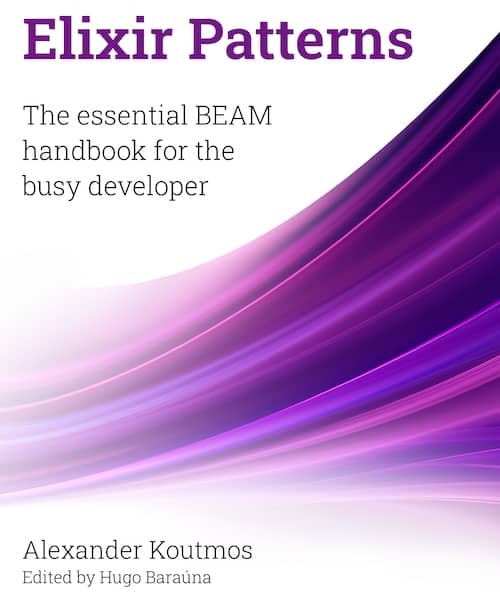
Elixir Patterns (PragProg)
Alexander Koutmos @akoutmos
Elixir Patterns aims to surface the powerful and unique characteristics of the Erlang virtual machine and show you how to solve everyday problems in a simple yet scalable way. Not only will you master the tools at your disposal courtesy of Erlang and the BEAM, you will also learn how to better utilize functional programming in order to achieve your goals in a clear and concise way. The idea of having a “go-to” toolbox of patterns you can leverage is an enticing one - that is what design patterns are all about! This book forgoes the abstract and instead provides concrete examples to help you better leverage the unique properties of Elixir, Erlang, and BEAM.
The Erlang programming language was first released in 1986 and to this day continues to have a tremendous impact on the field of computer programming. This impact is apparent when you look at how many other programming languages have actor model frameworks that mirror the semantics of Erlang and how many recent programming languages have emerged that make use of functional programming concepts. In addition, while many other programming languages and their runtimes require external tools in order to deal with application crashes, users of the Erlang virtual machine (or BEAM as it is colloquially called) enjoy fault-tolerant constructs that are built right into the runtime.
While the Erlang syntax may not be for everyone, we can still leverage the benefits of Erlang and the BEAM through the Elixir programming language. Elixir provides us an alternative programming language that can target the same runtime as Erlang while also leaning on the Erlang standard library. You essentially get all of the benefits of Erlang and the BEAM along with all of the tools available to you through the Elixir standard library.
This book guides you through the Erlang standard library and how you can leverage it from Elixir as well as how you can structure applications in order to make the most out of the unique runtime that is the BEAM. By the end of this book you will be comfortable constructing your own supervision trees, using processes, leaning on ETS and persistent term for when performance is a primary concern, and how you can use both the mutable and immutable data structures that are available in the Erlang standard library. In addition, you’ll learn how you can package these language and runtime primitives into reusable patterns in order to solve common problems that you may encounter in your day to day applications.
This work was written and produced entirely by the author. We are proud to be distributing it.
Alexander Koutmos has been professionally writing software for over a decade and has been primarily working with Elixir since 2015. He currently maintains a number of Elixir libraries on Hex, is a host on the BEAM Radio podcast, and wrote a book about Building a Weather Station with Nerves and Elixir.
Full details: Elixir Patterns: The essential BEAM handbook for the busy developer by Alexander Koutmos
Don’t forget you can get 35% off with your Devtalk discount! Just use the coupon code “devtalk.com" at checkout 
Most Liked

AstonJ
Edit: Please note this book is now distributed by PragProg so the original thread (this post, all the way down to this post) has been merged into this thread.
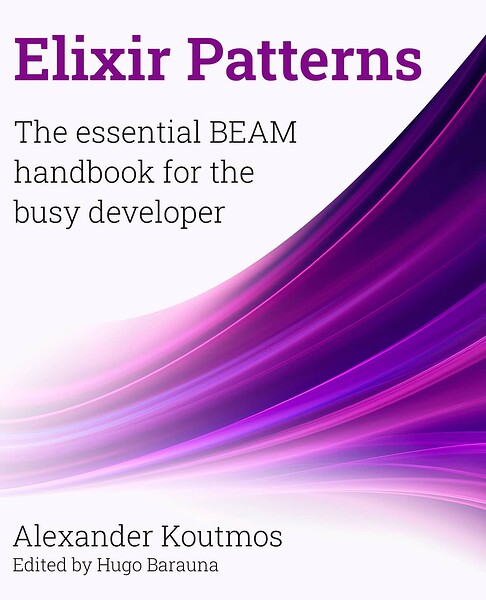
By @akoutmos and @hugobarauna
You already know the basics of Elixir. Maybe you have even shipped something to production. That’s awesome! But how can you go one step further in your Elixir developer journey?
This book will help you to become a better Elixir developer by teaching you how to leverage the power of the BEAM runtime with recipes and patterns specific to Elixir/OTP.
About the book
The idea of having a “go-to” toolbox of patterns that you can leverage is an enticing one. That’s what design patterns are about. But, design patterns are usually abstract and do not leverage unique properties of your specific run-time or language. That’s how this book is different.
This book aims to surface the powerful and unique characteristics of the Erlang virtual machine (or BEAM for short) and show you how you can go about solving everyday problems in a simple yet scalable way.
Not only will you learn how to better leverage the tools that are at your disposal courtesy of Erlang and the BEAM, but you will also learn how to better utilize Functional Programming in order to achieve your goals in a clear and concise way. You’ll start off by learning about some of the Erlang standard library utilities that are available to you right out of the box, and then you’ll learn how to put those to use in your stateful GenServer powered applications.
What you’ll learn in this book:
- The Erlang Standard Library Part 1
- What are Data Structures
- Using Queues in Erlang
- The Many Set Implementations in Erlang
- Arrays…in Erlang?
- Using the Erlang Module for Everyday Tasks
- The Erlang Standard Library Part 2
- Directed Graphs with the Digraph Module
- Fast Incrementers with Atomics and Counters
- Blazing Fast Data Reads with Persistent Term
- Using ETS and DETS for General Purpose Data Storage
- Keeping Things Secret with the Crypto Module
- The Elixir Standard Library
- Useful Enum Module Patterns
- Being Lazy with the Stream Module
- Massive Concurrency with the Task Module
- The Process Module
- GenServers and Supervisors
- Erlang Application Philosophy
- What is a GenServer?
- Understanding the Callbacks
- The Lifecycle of a GenServer
- What is a Supervisor
- Combining Supervisors and GenServers
- Basic GenServer Recipes
- Initializing an Application
- Message and Data Batching
- Running Cron Jobs
- Process Introspection with the Sys Module
- Advanced GenServer Recipes
- Rate Limiting
- Work Delegator
- Actor Model Design
- Testing Stateful Applications
- Application Release Packaging
- What is an Erlang Release
- Why Should you use Erlang Releases?
- Handling Application Configuration
- Behaviours and Protocols for Environment Specific Adapters

akoutmos
Apologies for the delay with the Elixir Patterns book. My wife and our newborn both fell very ill back in February and I had to put a pause on pretty much everything from the book, open source, blogging, podcasting and everything inbetween in order to take care of the family. My wife was fairly close to death’s door, but thank God she has recovered and is improving day by day. Still a long way to go but we’re getting there.
I am hoping that I will be back to writing the book in a few weeks. And after that hopefully back to doing some open source work. It’s been a long road for the family and I appreciate all the support from the Elixir community  .
.
akoutmos
@hugobarauna and I have some fantastic news…the Elixir Patterns books is complete and in release candidate!!
The eighth and final chapter dives into:
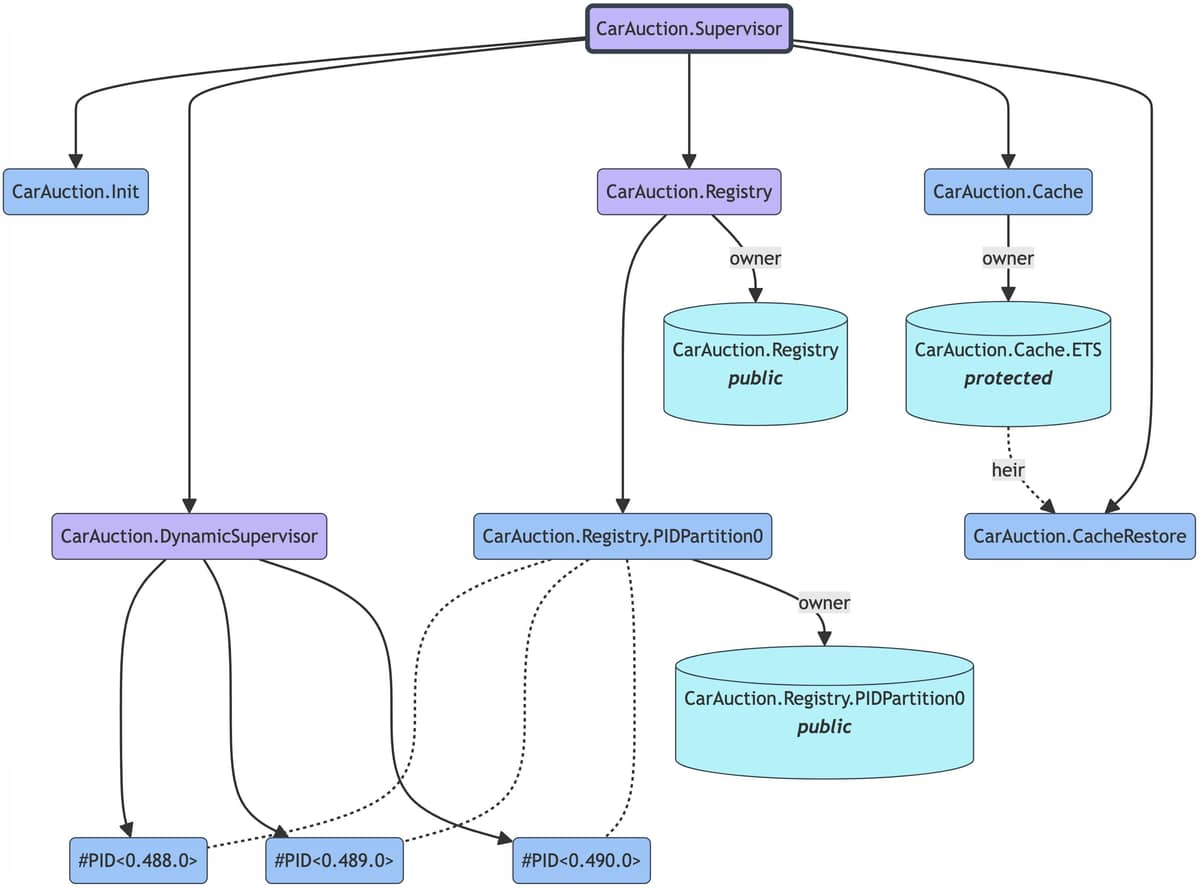
- Building a Scalable Actor Model with Caching Support: Learn how to architect a high-performance, fault-tolerant system using GenServers, ETS, and DynamicSupervisor.
- Implementing a Fault-Tolerant ETS Cache: Discover techniques to make your ETS caches resilient to failures, ensuring that your system can recover and maintain state even after unexpected process crashes.
- Adapter Pattern in Elixir: Understand how to use Elixir’s behaviours to implement the adapter pattern, allowing you to easily swap out dependencies at run-time or compile-time.
Here is a sneak peak at the final boss supervision tree 
This is the first release candidate of Elixir Patterns which means that the book’s content is complete, but we expect minor adjustments and potential errata. If you haven’t so already, be sure to pick up your copy at: https://elixirpatterns.dev/
akoutmos
@hugobarauna and I excited to announce the the Elixir Patterns book is in beta release! Part one of the book is complete and we’re currently working on wrapping up part 2. Each chapter has a couple of accompanying Livebook files to help you learn and experiment with the concepts in the chapter. Check it out @ https://elixirpatterns.dev/ and if you are interested in picking up a copy, you get an early beta price 

akoutmos
Just released the next round of content (PDF and Livebooks)!. We also got a fresh new cover . Really excited about this release and happy to get it into readers hands!
We’re still running the beta price so be sure to get your copy if you haven’t already : https://elixirpatterns.dev/

Popular in Books


Other popular topics






Latest on Elixir Forum
Sponsor Spotlight

Build Elixir applications with speed and confidence.
Categories:
Sub Categories:
Forums
Our Sponsors
Build Elixir applications with speed and confidence.

Supporting innovation across the BEAM ecosystem.

We build reliable cloud platforms for business-critical systems.

Catch errors, track performance, monitor hosts and more.

Practical resources that improve the lives of professional developers.

Develop your skills with books, videos, and courses.

Producing high quality Elixir screencasts since 2017.

Courses that'll move you from confusion to "Aha, now I get it!"