
jay1
Why isn’t mnesia the most preferred database for use in Elixir/Phoenix?
Why is it that the mnesia database isn’t the most preferred database for use in Elixir/Phoenix?
Most Liked

cmkarlsson
The short answer is: because it is not a traditional relational database. Postgres, MySQL or other RDBMS are preferred if you need persistence for general purpose systems.
The main use cases I see (and use) for mnesia:
- Configuration data. If I remember correctly this was the initial use case for mnesia
- As a (distributed) caching layer or for other ephemeral data (instead of redis/memcache etc)
- If your data structure fits nicely with the key/value approach and you don’t need to scale to a massive number of nodes.
I think mnesia is cool and should be used more when the use case fits but it does require you to acquire some specialist knowledge

keathley
The main reason I tell people to avoid mnesia is that most people coming to elixir aren’t ready to handle mnesia’s lack of consistency. Most people who use mnesia either handle this limitation on their own or just accept that at some point they’re going to lose data. Mnesia has some other technical limitations once you put a decent amount of data in it. These are typically things like slow startup times (since it needs to read everything back into memory) and table limits (iirc certain table types have a 2gig max table size). But consistency is the big reason.
EDIT:
This is a good read on the subject: https://medium.com/@jlouis666/mnesia-and-cap-d2673a92850

Exadra37
Thanks for the link to the very informative video.
I took a bunch of notes, some may be not totally correct, missing bits or not well understood by me, but anyway I will leave them here for others to review and point me where I am not getting it 
MNESIA FOR THE CAPper
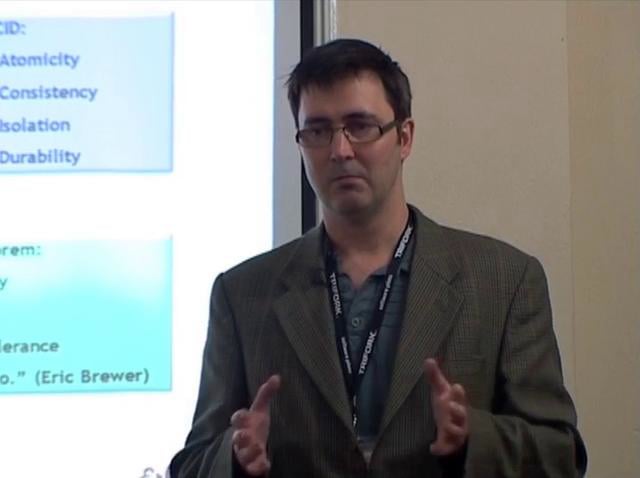
The good stuff
- Runs in same memory space of Erlang, thus very fast access, not matched by other databases.
- Stores data as Erlang terms.
- The query language is Erlang list comprehensions.
- If a crash occurs and leaves the filesystem with severe corrupted files, that
Mnesia is not able to repair, then it will refuse to start. If in a cluster we can delete the files and restart Mnesia, nad it will go to the other n odes to grab the necessary files to start and populate back the data. - Mnesia transactions assume that the functions running inside the transaction don’t have side effects, aka they only work with the database API, thus no message passing to other processes or whatever. Also Mnesia dirty operations cannot be done inside a transaction, otherwise nasty surprises may arise.
- For each transaction Mnesia creates a temporary ETS tables and writes to it.
- Mnesia supports transactions inside transactions, but you can take a performance penalty due to all necessary copy of data between the ETS temporary tables it creates for each table.
- Fragmentation of tables use linear hashing to distribute the data among them, but a callback exis ts to allow us to implement other type of hashing, like consistency hashing.
- We can extend Mnesia functionality by using callback Modules, but care needs to be taken.
- Using sticky locks to have data only in one node will eliminate the need for that node to have to communicate with other nodes, thus speeding up the operations. Regarding dead locks the author of the talk has the lock repo that is a scalable deadlock resolver.
- Incremental backups module.
- Install fall-back are useful to use in a system upgrade. For example to revert a database to a backup in case of any node fails to upgrade.
- Mnesia does not have geographic redundancy, but once transaction logic is not time sensitive, thus can use slow networks, therefore you can use the fact that we can geographically put nodes wherever we want to implement one, provided that each node have a copy of the schema, then allowing for each node to receive a copy of any schema update. It’s wacky but possible.
The bad stuff
- Using DETS it’s limited to 2GB and Mnesia will not tell that we are reaching or have exceed the limit, because it doesn’t tell how much memory is being used. Nowadays a better alternative exists, that is to not use DETS at all, thus instead of using
disk_only_copieswe may want to usedisc_copiesfor persistence, that will use the more recentdisk_logto write the data into disk. - No versioning of tables or metadata, therefore in a system upgrade that requires to change the schema definition and/or data shape we cannot use the strategy of upgrading a node at a time, because once a node updates it schema it will immediately propagate it to all other connected nodes in the Mnesia cluster.
- Brain splitting or network partition. This happens when a network failure occurs between nodes while they are still up, thus they still accept writes, therefore when they get connected back they will have an inconsistent state and Mnesia will refuse to merge them, leaving to us developers that task. Any automatic method that we can devise to handle this automatically may incur in data loss.
- A function exists to set what are the master nodes, thus allowing for Mnesia to pick one of them and discard the others, but this may also incur in some data loss, but at least the system will continue to work with a “consistent” database, based on the master node.
- We can listen to the event for the brain split and hook into a function that will allow us to run our code to merge and solve the conflicts.
- The vector lock implementation used by Riak can be added to the table metadata to be used for automatically try to resolve the merge of data in a brain split.
- Tables can be locked while we are trying to solve and merge the conflicts.
- The author of the talk have release the unsplit repo to deal with all this.
- Mnesia overload can happen in two ways.
- When we too many and fast writes that are replicated to other nodes, a node may be slower and start building a queue. It’s from probable to happen with dirty writes then with transactions. Either way Mnesia will report it’s overloaded, but it’s really very hard to detect it’s about to happen in order to prevent it from happening.
- When disc copies are used Mnesia will create transaction commit logs and periodically flush them to the disk, and when they start to overlap(aka a new one is created before the other finishes to flush to disk) Mnesia will tell you it’s overlapped.
- Mnesia was not telling us when is not any-more overloaded, thus not allowing us to build a load mechanism that would allow for back-off when overloaded and to resume to full speed when recovered. After release 14b it seems that will exist an API to allow to build a Load Framework, that the presenter of the talk is thinking in building and release. The closest I could find in his Github was a job scheduler for load regulation in this repo.
- No safe replication with dirty writes.
- No built in geographic redundancy.
Other Backend for Mnesia
He mentions something about looking at Bitcask as a possible interesting backend…
I think is talking about the Riak one, that we can find in this repo.

rvirding
I don’t understand what you mean here with “lack of consistency”. If you use mnesia’s transactions then you are guaranteed that when the transaction has completed then all mnesia nodes are consistent. It is only if you use the “dirty” API you don’t get this guaranteed consistency.
cmkarlsson
I think he might be talking about CAP theorem consistency. If you have multiple nodes in mnesia netsplits must be dealt with in the application layer. There are various ways of doing it (majority nodes, and https://github.com/uwiger/unsplit are the ones that pop into my mind). But the basic case to solve a netsplit is to pick a node and restart the others. If you picked the wrong one (or even the right one) you will lose data.
In addition there is no actual guarantees an mnesia transaction actually persists to disk. The mnesia cluster does a two phase commit so it knows that all the nodes have received it but each node does not force a disc sync. I think RabbitMQ even modified mnesia (or added a function or something) to make the transactions sync to disk.
Popular in Questions









Other popular topics




 Latest Phoenix Threads
Latest on Elixir Forum
Sponsor Spotlight

Practical resources that improve the lives of professional developers. By developers, for developers.
Categories:
Sub Categories:
Forums
Our Sponsors

Build Elixir applications with speed and confidence.

Supporting innovation across the BEAM ecosystem.

We build reliable cloud platforms for business-critical systems.

Catch errors, track performance, monitor hosts and more.
Practical resources that improve the lives of professional developers.

Develop your skills with books, videos, and courses.

The deployment platform built for Elixir: PaaS ease, VPS control.

Courses that'll move you from confusion to "Aha, now I get it!"