
PragmaticBookshelf
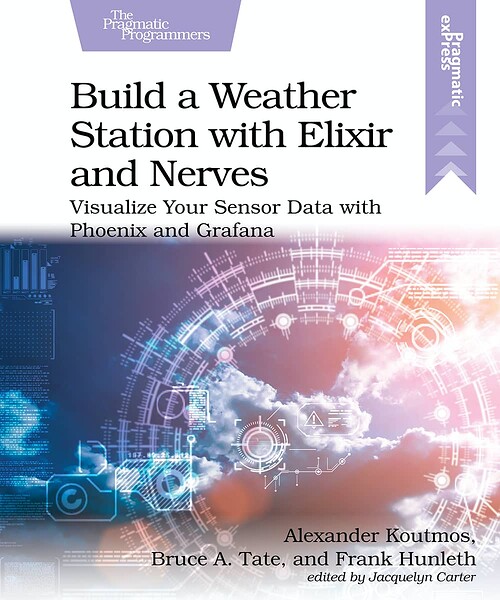
Build a Weather Station with Elixir and Nerves (PragProg)
Alexander Koutmos
Bruce A. Tate @redrapids
Frank Hunleth @fhunleth
edited by Jacquelyn Carter @jkcarter
The Elixir programming language has become a go-to tool for creating reliable, fault-tolerant, and robust server-side applications. Thanks to Nerves, those same exact benefits can be realized in embedded applications. This book will teach you how to structure, build, and deploy production grade Nerves applications to network-enabled devices. The weather station sensor hub project that you will be embarking upon will show you how to create a full stack IoT solution in record time. You will build everything from the embedded Nerves device, to the Phoenix backend and even the Grafana time-series data visualizations.
Elixir as a programming language has found its way into many different software domains, largely in part to the rock solid foundation of the Erlang virtual machine. Thanks to the Nerves framework, Elixir has also found success in the world of embedded systems and IoT. Having access to all of the Elixir and OTP constructs such as concurrency, supervision, and immutability makes for a powerful IoT recipe. Find out how to create fault-tolerant, reliable, and robust embedded applications using the Nerves framework.
Build and deploy a production grade weather station sensor hub using Elixir and Nerves, all while leveraging the best practices established by the Nerves community for structuring and organizing Nerves applications. Capture all of your weather station sensor data using Phoenix and Ecto in a lightweight server-side application. Efficiently store and retrieve the time-series weather data collected by your device using TimescaleDB (the Postgres extension for time-series data). Finally, complete the full stack IoT solution by using Grafana to visualize all of your time-series weather station data. Discover how to create software solutions where the underlying technologies and techniques are applicable to all layers of the project.
Take your project from idea to production-ready in record time with Elixir and Nerves.
Alexander Koutmos has been writing software professionally for almost a decade and has been working primarily with Elixir since 2016. He currently maintains a few Elixir libraries on Hex and also runs a software consultancy (www.stagira.com).
Bruce Tate is a kayaker, programmer, and father of two from Chattanooga, Tennessee. The author of more than 10 books has been around Elixir from the beginning. He is the founder of Groxio, a company that trains Elixir developers.
Frank Hunleth is an embedded systems programmer, OSS maintainer, and Nerves core team member. When not in front of a computer, he loves running and spending time with his family.
- Full details: /titles/passweather/build-a-weather-station-with-elixir-and-nerves/
- View this book’s portal and details on how to post errata and suggestions here.
Don’t forget you can get 35% off with your Devtalk discount! Just use the coupon code “devtalk.com" at checkout 
Most Liked

stefanluptak
OK, so I found an european e-shop, that has all the parts in stock, except for the Raspi. Raspi is in stock in another e-shop we have here. Also, I didn’t link the MicroSD card + reader and the micro USB cables, since I own these already. Hope this could help somebody. 
| Name | Manufacturer code | Price € | Link |
|---|---|---|---|
| Qwiic pHAT 2.0 | DEV-15945 | 7,54 | https://www.distrelec.sk/sk/modul-qwiic-phat-v2-pro-raspberry-pi-sparkfun-electronics-dev-15945/p/30173928?track=true&no-cache=true&marketingPopup=false |
| VEML6030 Light Sensor | SEN-15436 | 7,43 | https://www.distrelec.sk/sk/veml6030-ambient-light-sensor-breakout-sparkfun-electronics-sen-15436/p/30157563?track=true&no-cache=true&marketingPopup=false |
| SGP30 Air Quality Sensor | SEN-16531 | 21,94 | https://www.distrelec.sk/sk/sgp30-qwiic-air-quality-sensor-sparkfun-electronics-sen-16531/p/30216196?track=true&no-cache=true&marketingPopup=false |
| BME680 Environmental Sensor | SEN-16466 | 21,47 | https://www.distrelec.sk/sk/bme680-qwiic-environmental-sensor-breakout-sparkfun-electronics-sen-16466/p/30216193?track=true&no-cache=true&marketingPopup=false |
| Qwiic Cables 50mm | PRT-14426 | 1,13 | https://www.distrelec.sk/sk/qwiic-cable-1mm-jst-50mm-sparkfun-electronics-prt-14426/p/30160896?track=true&no-cache=true&marketingPopup=false |

akoutmos
 Beta 2 of the book has just landed
Feel free to check it out at: Build a Weather Station with Elixir and Nerves: Visualize Your Sensor Data with Phoenix and Grafana by Alexander Koutmos, Bruce A. Tate, Frank Hunleth
The updates for this beta include the addition of chapter 4 and chapter 5 as well as addressing some errata. Chapter 4 goes over how to publish data from your Nerves device to a Phoenix API that you will be writing. The Phoenix API is backed by TimescaleDB so you can store and query all that time-series goodness  . Chapter 5 goes over how to set up Grafana and how to visualize your time-series data that is stored in TimescaleDB. By the end of the book you’ll be able to build a (near) real-time weather dashboard like so:

Be sure to check it out and feel free to reach out with any feedback! Happy hacking  .
.

margareteldridge

kip
Purchased. Been itching to get into nerves for a while (haven’t wielded a soldering iron in anger since 555 timer chips were a thing).
stefanluptak

Popular in Books




Other popular topics





 Latest Nerves Threads
Latest on Elixir Forum
Sponsor Spotlight

Build Elixir applications with speed and confidence.
Categories:
Sub Categories:
Forums
Our Sponsors
Build Elixir applications with speed and confidence.

Supporting innovation across the BEAM ecosystem.

We build reliable cloud platforms for business-critical systems.

Catch errors, track performance, monitor hosts and more.

Develop your skills with books, videos, and courses.

Producing high quality Elixir screencasts since 2017.

Enabling companies to succeed by building software people love.

Courses that'll move you from confusion to "Aha, now I get it!"