
PragmaticBookshelf
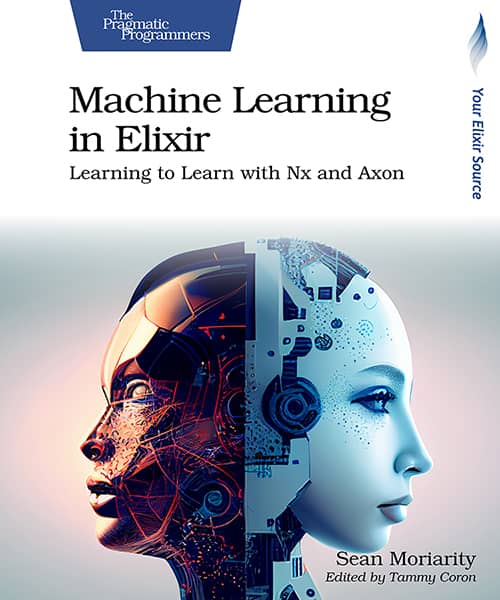
Machine Learning in Elixir (PragProg)
Sean Moriarity @seanmor5
edited by Tammy Coron @Paradox927
Stable Diffusion, ChatGPT, Whisper—these are just a few examples of incredible applications powered by developments in machine learning. Despite the ubiquity of machine learning applications running in production, there are only a few viable language choices for data science and machine learning tasks. Elixir’s Nx project seeks to change that. With Nx, you can leverage the power of machine learning in your applications, using the battle-tested Erlang VM in a pragmatic language like Elixir. In this book, you’ll learn how to leverage Elixir and the Nx ecosystem to solve real-world problems in computer vision, natural language processing, and more.
The Elixir Nx project aims to make machine learning possible without the need to leave Elixir for solutions in other languages. And even if concepts like linear models and logistic regression are new to you, you’ll be using them and much more to solve real-world problems in no time.
Start with the basics of the Nx programming paradigm—how it differs from the Elixir programming style you’re used to and how it enables you to write machine learning algorithms. Use your understanding of this paradigm to implement foundational machine learning algorithms from scratch. Go deeper and discover the power of deep learning with Axon. Unlock the power of Elixir and learn how to build and deploy machine learning models and pipelines anywhere. Learn how to analyze, visualize, and explain your data and models.
Discover how to use machine learning to solve diverse problems from image recognition to content recommendation—all in your favorite programming language.
Sean Moriarity is author of Genetic Algorithms in Elixir: Solve Problems using Evolution, co-creator of the Nx library, and creator of the Axon deep learning framework. Sean’s interests include mathematics, machine learning, and artificial intelligence.
- Full details: Machine Learning in Elixir: Learning to Learn with Nx and Axon by Sean Moriarity
- View this book’s portal and details on how to post errata and suggestions here.
Don’t forget you can get 35% off with your Devtalk discount! Just use the coupon code “devtalk.com" at checkout 
Most Liked

josevalim
If it is of any help, I am deep into AI in the last 2 years and I still can’t understand most Hugging Face projects. But I think that’s ok: I also don’t understand most of what is on GitHub, except for things written in certain languages, like Elixir or Erlang.
Therefore, the book will give you similar context. It is unlikely you will fully grasp any Hugging Face model, but there are certain models, architectures, and problems that will make a lot more sense once you read it.
Unfortunately there is no quantization at the moment but we are working on it. You can fine-tune models and one of the chapters discuss it, but you will most likely need a GPU and that’s one particular area we want to further improve the UX on.

pragprog

Can’t tell you how much kind words mean to both the author and to helping the book. Thank you!
The social media with this will go live in a few hours

gbarkhatov
You guys are the best publisher in the whole code world. No matter what book I choose. The content, edits and overall stuff is awesome 

cjbottaro
I’ve been doing software development for 25 years now and have never before felt so lost and behind as when it comes to AI. I tried poking around Hugging Face and just have absolutely no idea what is going on.
Will this book help navigate that world? Also, is it possible to quantize and fine tune foundation models using Elixir and these libraries like Nx and Axon (I’m not even sure I’m using the proper terminology here)?
Thanks for the info!

shawn_leong
Hey @shahryarjb, I haven’t made it through the Preface yet but it does write the following here. Hope it helps
This book is for programmers interested in learning machine learning in Elixir
and programmers with prior Elixir or machine learning experience.
Elixir programmers can pick up and read this book with no prerequisite
knowledge of machine learning, mathematics, or numerical computing, as
this book will teach you everything you need to know from the basics on.
Programmers with machine learning experience but no Elixir experience will
be able to follow along, but some syntactic details and functional concepts
might seem unfamiliar. If you fit into this category, I recommend keeping the
Elixir documentation handy to reference some language details that this book
omits.
If you have no machine learning or Elixir experience, then learning both Elixir
and machine learning at the same time will be a difficult task. Therefore, I
recommend getting familiar with Elixir first and then returning to this book
to learn machine learning in Elixir.
Popular in Books





Other popular topics








Latest on Elixir Forum
Sponsor Spotlight

Develop your skills with books, videos, and courses.
Categories:
Sub Categories:
Forums
Our Sponsors

Build Elixir applications with speed and confidence.

Supporting innovation across the BEAM ecosystem.

We build reliable cloud platforms for business-critical systems.

Catch errors, track performance, monitor hosts and more.

Producing high quality Elixir screencasts since 2017.

Enabling companies to succeed by building software people love.

The deployment platform built for Elixir: PaaS ease, VPS control.

Courses that'll move you from confusion to "Aha, now I get it!"