
qhwa
Tablex - an implementation of Decision Table in Elixir, for easy-to-read business rules
Hi all!
I’m excited to share with you my recent work on making business rules easier to maintain.
Tablex is an implementation of Decision Table in Elixir. A decision table can make rules more obvious to human brains. Hence we can easily spot the mistakes in rules. Since they are simple markups, Elixir developers can transfer the responsibility of maintaining the domain business rules to operation teammates.
Tablex is heavily inspired by Decision Model and Notation (DMN) and borrowed its ideas of decision tables and friendly expression language. While DMN uses XML to present the decision table, Tablex uses easier-to-read plain texts, such as:
F score   || result
1 >=90    || A
2 60..89  || B
3 -       || C
What is it related to Elixir?
As a library, Tablex has the following abilities:
- Parsing the above text into a rich Elixir struct,
%Tablex.Table{...}. - Compiling the above text into corresponding Elixir code that uses pattern matching. (doc)
- Allowing employing functions in the output definition to be your domain rule engine. (doc)
- Allowing displaying decision tables in HTML pages with the help of TablexView
In a word, it allows you to work with your business rules conveniently.
Let’s see a more real-life example:
The following Elixir code defines what settings for a given place (identified by city and area id) are:
default_settings = %{
  feature1: [
    param1: 5,
    param2: 0
  ],
  feature2: [
    param1: 0.6,
    param2: 60
  ],
  feature3: [
    feature3_1: [
      param1: 0.75,
      param2: ["SOMETHING"]
    ],
    feature3_2: [
      param1: 0.75,
      param2: ["SOMETHING"]
    ]
  ],
  feature4: false,
  feature5: false,
  feature6: [
    feature6_1: true,
    feature6_2: true,
    feature6_3: false
  ],
  feature7: "provider1",
  feature8: false
}

case target do
  %{city: "Vancouver"} ->
    %{default_settings | feature8: true}

  %{area_id: 2053} ->
    default_settings
    |> put_in([:feature6, :feature6_3], true)
    |> put_in([:feature8], true)
    |> put_in([:feature3, :feature3_1, :param2], ["SOMETHING", "ANOTHER"])
    |> put_in([:feature3, :feature3_2, :param2], ["SOMETHING", "ANOTHER"])

  %{area_id: area_id} when area_id in [7839, 2407, 21094, 62124] ->
    default_settings
    |> put_in([:feature4], true)
    |> put_in([:feature8], true)

  %{area_id: area_id} when area_id in [23982, 2407, 2462, 2179] ->
    %{default_settings | feature7: "provider2"}

  %{area_id: area_id} when area_id in [2060, 2413, 2407, 2417, 2396, 2419] ->
    default_settings
    |> put_in([:feature8], true)
    |> put_in([:feature6, :feature6_3], true)

  _ ->
    default_settings
end
With Decision Table, we can describe almost the same logic in a tabular text block:
====
R                           || 1           2         3                  4                     5                     6
target.city                 || -           Vancouver -                  -                     -
target.area_id              || -           -         2053               7389,2407,21094,62124 23982,2407,2462,2179  2060,2413,2407,2417,2396,2419
====
feature1.param1             || 5           -         -                  -                     -                     -
feature1.param2             || 0           -         -                  -                     -                     -
feature2.param1             || 0.6         -         -                  -                     -                     -
feature2.param2             || 60          -         -                  -                     -                     -
feature3.feature3_1.param1  || 0.75        -         SOMETHING,ANOTHER  -                     -                     -
feature3.feature3_1.param2  || [SOMETHING] -         -                  -                     -                     -
feature3.feature3_2.param1  || 0.75        -         -                  -                     -                     -
feature3.feature3_2.param2  || [SOMETHING] -         SOMETHING,ANOTHER  -                     -                     -
feature4                    || Y           -         -                  Y                     -                     -
feature5                    || N           Y         -                  -                     -                     -
feature6.feature6_1         || Y           -         -                  -                     -                     -
feature6.feature6_2         || Y           -         -                  -                     -                     -
feature6.feature6_3         || N           -         Y                  -                     -                     Y
feature7                    || provider1   -         -                  -                     provider2            -
feature8                    || N           -         Y                  Y                     -                     Y
I said “almost the same” because the settings differ between the Elixir code and the table when the area id is 2407. The maintainer of the code intended to set multiple settings for area #2407 with different clauses of pattern matching. But he didn’t know that only the first matched clause was hit. This mistake was quickly spotted when the rules were present on a table.
Also, here we use R, the reverse merge hit policy so that settings will be merged with all hit rules from right to left. So rules #6, #5, #4, and #1 will all impact the final result.
The textural table is easy to read and can be further visualized with HTML:
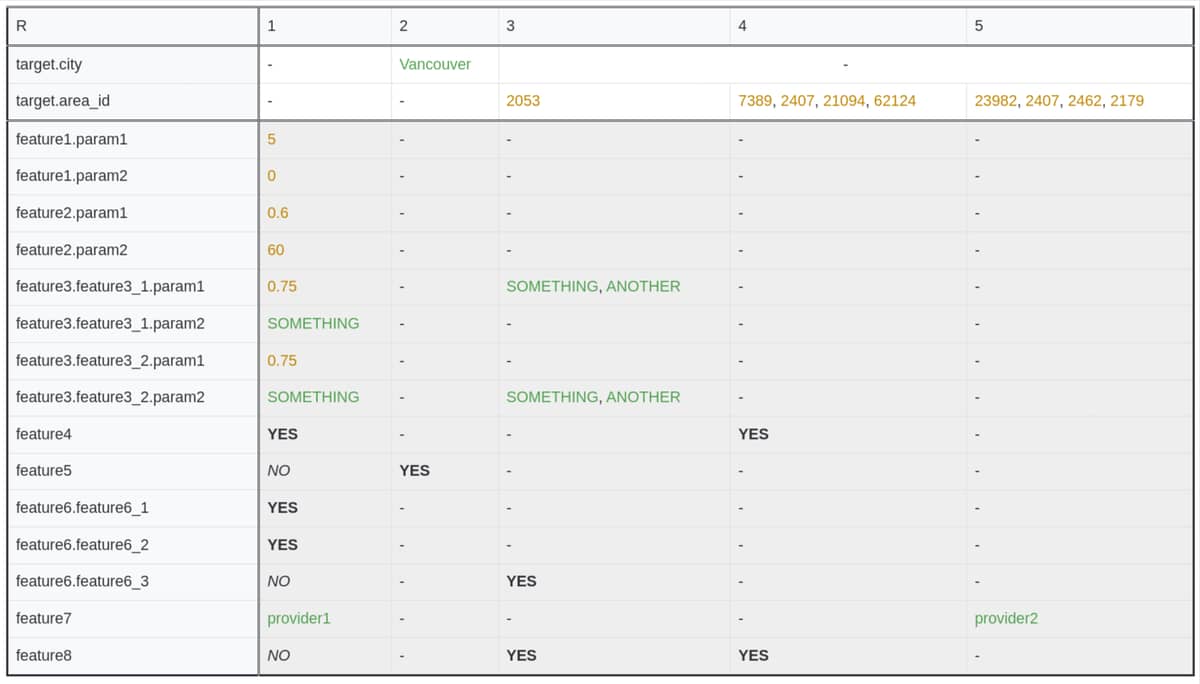
(generated by TablexView)
Roadmap
1.0
- formatter
- expression specification
1.1
- more data types (Date, Time, and DateTime)
Current status
It’s still a very early stage for Tablex, although it has been used in production. Currently, the latest version is 0.3.1.
I hope you can find this helpful to you. Feedback is welcome! Thanks!
Most Liked
qhwa
New version released today: v0.2.0-alpha.1, with many exciting changes:
- An optimizer is added for optimizing the rules, for example, to remove duplicated or unreachable rules.
- A formatter that can format the table text so that the style is persistent.
- Some APIs for getting or updating rules, so that the rules can be programmably managed without handwriting tables.
- Add support for structs as decision arguments (PR), thanks to László Hegedüs
- Improvement on development, such as allowing development on Elixir 1.14, and adding CI, thanks to James Every
I’m very excited about what is ahead. Feedback is very welcome!
qhwa
New version released: v0.3.1, with some improvements and bugfixes:
- [BREAKING] Tablex no longer alters the case of a variable name. For example,
myFoowill stay asmyFoo. In contrast, previous versions will convert it tomy_foo. - Performance is significantly improved when generating Elixir code from tables.
qhwa
New version released: v0.2.0. Compared to v0.2.0-alpha.1, there are many changes:
- A better support for Emojis

- Bugfixes for the formatter
- Bugfixes for the optimizer
Popular in Libraries





Other popular topics



Latest on Elixir Forum
Sponsor Spotlight

Enabling companies to succeed by building software people love.
Categories:
Sub Categories:
Forums
Our Sponsors

Build Elixir applications with speed and confidence.

Supporting innovation across the BEAM ecosystem.

We build reliable cloud platforms for business-critical systems.

Catch errors, track performance, monitor hosts and more.

Develop your skills with books, videos, and courses.

Producing high quality Elixir screencasts since 2017.
Enabling companies to succeed by building software people love.

Courses that'll move you from confusion to "Aha, now I get it!"